

The Vibe
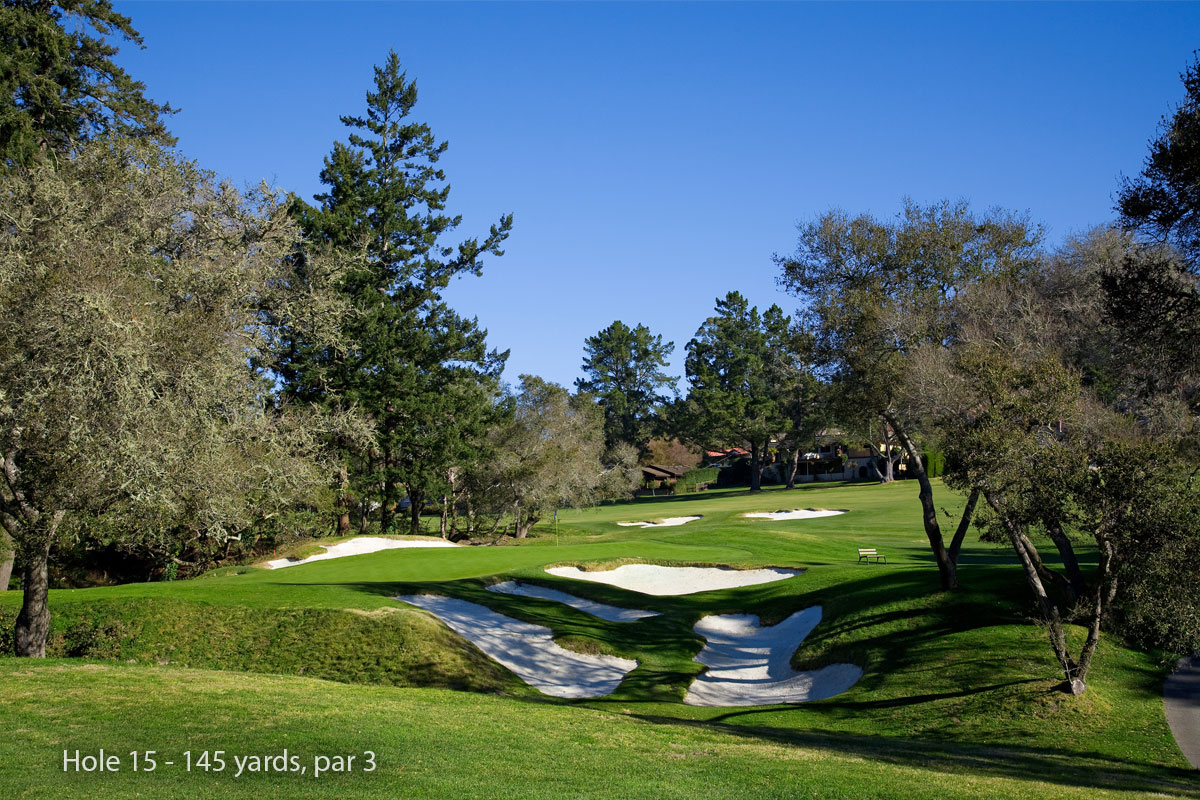
Pasatiempo is golf architecture in its purest form. There are no oceanfront theatrics or dramatic cliff-top par 3s. Instead, MacKenzie used the natural contours of the Santa Cruz hills—the deep barrancas (natural ravines), the rolling terrain, and the native live oaks—to create a course that rewards strategic thinking above all else. It has a distinctly understated, almost British feel. The clubhouse is unpretentious. The dress code is relaxed. And the greens are among the most complex and diabolical you'll find anywhere in the world. Tom Doak, the famous course architect, has called the 16th hole one of the finest par 4s in the United States. MacKenzie himself chose to live here over all his other creations—and when you stand on the 6th fairway and look back at where his house stood, you understand why.
The Vault Line — The Barranca Equation
Deep barrancas (natural ravines carved by water over millennia) cut across the fairways on multiple holes. The temptation is to carry them with a heroic shot. The Secret: MacKenzie always gave you a safe route. On holes like the 10th and 16th, the wide side of the fairway avoids the barranca entirely but leaves a longer, more angled approach. The narrow side tempts you to cut the corner but punishes a miss with a lost ball in the ravine. Ask yourself: "What would MacKenzie want me to do?" The answer is always the strategic play, never the brute-force play.
Quick-Glance Summary
Terrain
Hillside / Barrancas
Priority
Strategic Thinking
Aesthetic
Classic Understated
Status
MacKenzie Legacy
The Access Intelligence
Access Reality
Semi-Private | Public Welcome
Pasatiempo is a semi-private club that warmly welcomes outside play. Green fees are approximately $275–$325, which is exceptional value for a course of this historical and architectural significance. No resort stay required—just book online or call the pro shop. Hack: Twilight rates (after 2pm) drop to around $150, and in the summer months you'll still get 18 holes in with California's long evenings. The course is located just 75 minutes south of San Francisco, making it an easy day trip from the Bay Area.
Visit Official Club WebsiteTactical Strategy Guide
Hole 16 — The Masterpiece (Par 4, 395 yds)
Tom Doak ranks it among the finest par 4s in the country. A deep barranca cuts diagonally across the fairway at driving distance. The aggressive line over the barranca shortens the hole dramatically but demands a perfect carry of 240+ yards. The safe play is to lay up short of the ravine, leaving a longer but unobstructed approach to a green that slopes hard from back to front. Strategy: Unless you carry 260 yards consistently, lay up. The green is receptive to a full wedge from 140 yards but utterly rejects a running 7-iron from 170.
Hole 11 — The Par 3 That Breaks Hearts
A stunning downhill par 3 over a deep barranca to a narrow green that slopes away from you. Club selection is everything. Strategy: The green is approximately 15 feet below the tee, so play one club less than the yardage suggests. Aim for the fat part of the green. The bailout area right is actually a good miss—a chip from there is far easier than trying to salvage par from the barranca.
The MacKenzie Greens — Universal Approach
MacKenzie's greens here share DNA with Augusta National: multi-tiered, with pronounced slopes that can turn a 12-footer into a 40-footer if you're on the wrong level. Strategy: Always be below the hole. A putt from below the hole is a confidence boost; a putt from above the hole is a prayer. Plan your approach shots to land on the same tier as the pin, even if it means aiming away from the flag.
The Insider FAQ
Is this really MacKenzie's favourite course?
By every account, yes. Alister MacKenzie moved to Santa Cruz in 1932, built his home overlooking the 6th fairway of Pasatiempo, and lived there until his death on January 6, 1934. In his writings, he referred to Pasatiempo as his "dream course" and spent his final years refining and perfecting it. He is buried in the Santa Cruz area. Of all his designs—Augusta National, Royal Melbourne, Cypress Point—he chose to spend his final days at Pasatiempo.
How does it compare to Augusta National?
The greens share the same design philosophy: multi-tiered, with dramatic slopes that require precise distance control. But where Augusta has been extensively modified over the decades, Pasatiempo has been meticulously restored to MacKenzie's original vision (a major Tom Doak-led restoration was completed in 2007). In many ways, playing Pasatiempo gives you a more authentic MacKenzie experience than Augusta itself. The course is also significantly shorter (6,478 yards vs. Augusta's 7,500+), so it rewards strategy and precision over raw power.
Can I walk the course?
Absolutely, and it's encouraged. Pasatiempo is eminently walkable despite some elevation changes. The course flows naturally from green to tee with minimal transitions. Walking gives you time to appreciate the barranca features and the subtlety of MacKenzie's routing. Pull carts are available, or you can hire a caddie (recommended for first-timers). The course takes approximately 4 hours to walk.
What is the Tom Doak restoration?
In 2007, renowned architect Tom Doak (a devoted MacKenzie scholar) led a comprehensive restoration project. Over the years, Pasatiempo's greens had been shrunk by gradual mowing-line creep, bunkers had been softened, and several holes had been altered. Doak restored the original green complexes to their full MacKenzie dimensions, rebuilt bunkers to their original flash-faced style, and removed trees that had been planted in locations MacKenzie never intended. The result is the most authentic MacKenzie playing experience in America.
Is it worth the drive from San Francisco?
Unequivocally yes. The drive is approximately 75 minutes via Highway 17 through the Santa Cruz Mountains—one of the most scenic drives in the Bay Area. You can play a morning round, have lunch at the clubhouse (which has excellent food and sweeping views), and be back in San Francisco by late afternoon. Alternatively, stay overnight in Santa Cruz and pair Pasatiempo with Pacific Grove or the Monterey Peninsula courses for a multi-day architecture pilgrimage.